GUIDED TOUR OF THE TUGENDHAT HOUSE

Daniela and Ivo Hammer-Tugendhat, GUIDED TOUR OF THE TUGENDHAT HOUSE (2026*)

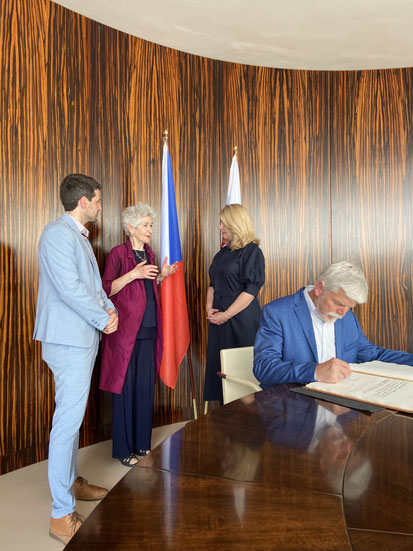
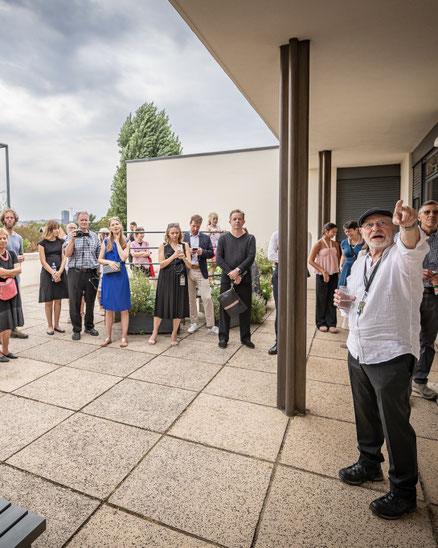
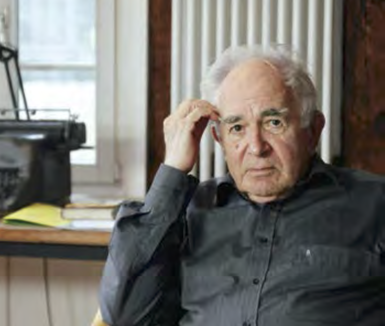
My name is Ivo Hammer-Tugendhat. I also speak on behalf of my wife, Daniela Hammer-Tugendhat, who passed away on September 17, 2025.
Daniela was the youngest daughter of Grete and Fritz Tugendhat, the builders of the Tugendhat House. Both parents came from Jewish families who were very successful with manufactories and factories, primarily in the textile industry. They were Czechoslovak citizens and among the approximately 55,000 residents of Brno, roughly a quarter of the population at the time, who predominantly spoke German.
OWNERS AND BUILDING HISTORY
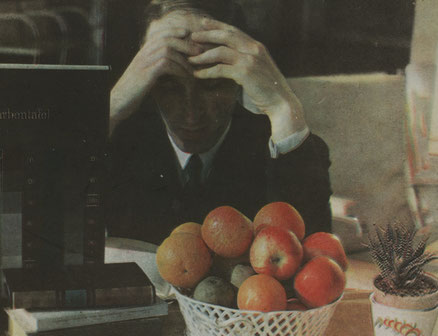
Grete Tugendhat's parents, Marianne and Alfred Löw-Beer, had lived in an Art Nouveau house built in 1904 in Brno, near the Augarten (Lušanky), since 1913.
On the occasion of her marriage to Fritz Tugendhat on June 30, 1928, in Berlin, Marianne and Alfred transferred to their daughter Grete the building plot belonging to the Art Nouveau house and their share in the company Moses Löw-Beer, which was declared a gift in March 1929. This share financed the construction costs for the Tugendhat House. It was not a gift, but rather an advance on her inheritance, thus avoiding any unfairness to Grete's four siblings.
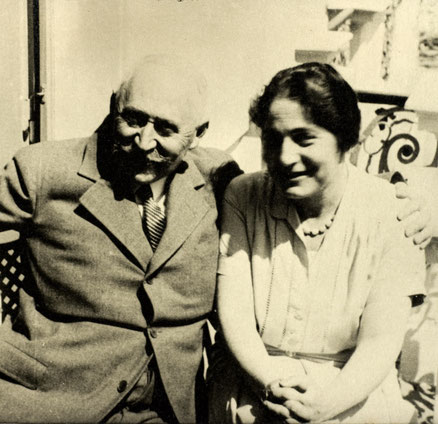

In the summer of 1928, Grete and Fritz Tugendhat had their first meeting with Ludwig Mies van der Rohe in Berlin about the building project in Brno. Mies van der Rohe told them, as Grete Tugendhat recounted, “that a house should never be built from the facade, but from the inside out; that windows in a modern building should no longer be holes in a wall, but rather a surface spanning between floor and ceiling, and as such, a structural element!”
Grete Tugendhat reported in 1969 that they were both so impressed by Mies van der Rohe’s personality during this conversation that they immediately decided “that he should build our house.”
Brno had been a European center of the Modern Movement architecture since around 1925, and many excellent architects worked there. After visiting contemporary buildings in Brno, for example, those by Ernst Wiesner, the couple remained committed to their decision to commission the German architect.
In September 1928, Ludwig Mies van der Rohe—likely accompanied by his partner Lilly Reich and his colleague Herman John—visited the building site in Brno. It can be assumed that the Berlin architects also visited the jubilee exhibition commemorating the 10th anniversary of the founding of Czechoslovakia, which was running at the Brno Exhibition Centre at the time, and probably gathered inspiration for the Tugendhat House.
On New Year's Eve 1928, Grete and Fritz Tugendhat arranged to visit Ludwig Mies van der Rohe's studio in Berlin. They were very impressed with the design, especially the floor plan of the enormous living room "with one freestanding circular and one freestanding rectangular wall." Grete said in 1969: "We immediately saw that this room was something unprecedented, something never seen before." A private house built with an iron frame, the walls are not load-bearing but allow for the flexible division and combination of living spaces. The steel columns stand in 'well foundations' because the sloping terrain is prone to landslides.
Mies only had to change the floor plan of the bedrooms: The steel supports were invisibly integrated into the walls, the children's rooms were made accessible via a passageway and a sliding door, and the windows on the garden façade were fitted with sunshades—roller shutters for the upper floor and a gray and white awning for the main room.
The family was able to move into the house at the beginning of December 1930.
THIRD FLOOR:
UPPER TERRACE
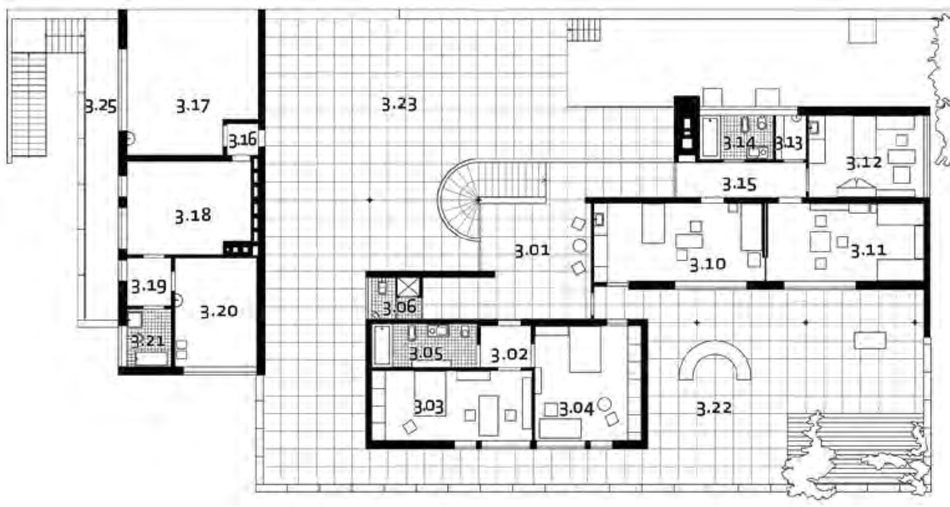

Adjacent to the upper terrace, with its magnificent view of the Brno cityscape and the garden, are the bedrooms of the parents and their children Hanna, Ernst, and Herbert, each with direct access to the terrace. The terrace served as a playground for the children. Japanese knotweed (Polygonum) growing on the southeast facade of Grete Tugendhat's bedroom, as well as on the pergola above the children's sandbox and on the semicircular bench, provided shade.
The facade, like the interiors, is not presented in bright colors, but rather according to the materials used: The steel pillars, clad in rounded brass sheets, have an artificial dark patina; the doors and windows with their wooden shutter boxes and blinds, and the terrace furnishings—including the semicircular bench, games table, pergola, and flower boxes—are painted a bluish metallic gray (with oil paint). The surface was originally sanded and given a metallic sheen by a clear oil varnish. The window sills were made of lead, which has oxidized to a bluish metallic gray.
The remaining parts of the facade appear in the yellowish-white color of stone: the sills, baseboards, and the terrace balustrade coping made of Italian travertine; the possibly partially original terrace flooring made of square terrazzo tiles; and the textured facade plaster with a thin lime wash tinted with fine sand. The fine sand in the wash also serves an essential technical function. In a larger 'archaeological window' on the east wall, which I created during the 2011 restoration together with the commissioned company Kodiak, the original yellowish-white facade surface is visible. The rest of the facade was painted with a lime wash using traditional repair techniques.
ENTRANCE
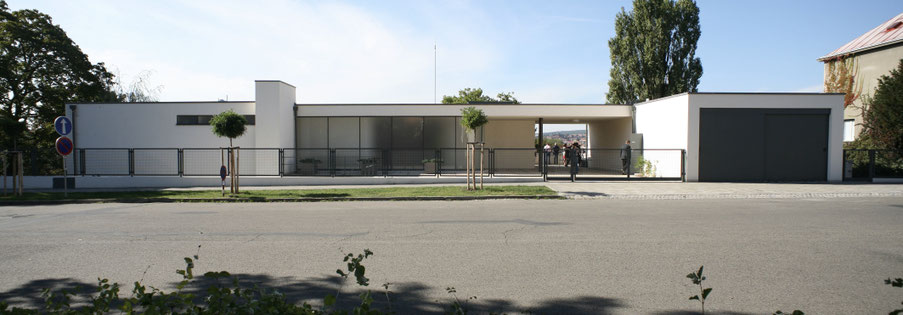
Viewed from the street, the building, as contemporary reactions confirm, does not appear to be a large residential building, but rather a low-rise utilitarian structure. However, the view between the service wing and the family apartment towards Špilberk is truly spectacular. The garage extends—in violation of building regulations—right up to the property line (a testament, perhaps, to the Brno authorities' openness to unconventional solutions). The driver's apartment adjoins the garage and is accessible via a gallery in the northwest. The entrance level connects seamlessly to the sidewalk, while the lower level houses the building's technical equipment (coal chute, ash elevator, and air conditioning).
The crack, for example, in the garage wall between the concrete ceiling and the traditional brick-and-mortar wall is unavoidable, essentially a construction defect. The crack is already visible in Rudolf de Sandalo's publication photos, where it has been retouched. It arises from the differing thermal expansion of the concrete ceiling and the brick-and-mortar walls. One could describe the crack as an aesthetic consequence of combining innovative and traditional building techniques.
The entrance is highly unusual: it is not visible. The semicircular wall of the foyer, resting on a travertine base and composed of enormous glass panes framed by bluish-gray oil-painted frames, and the patinated brass cladding of the steel column that alone bears the load of the flat roof, together with the terrazzo floor and the yellowish-white facade, appear as the thematic embodiment of the building's aesthetic concept.
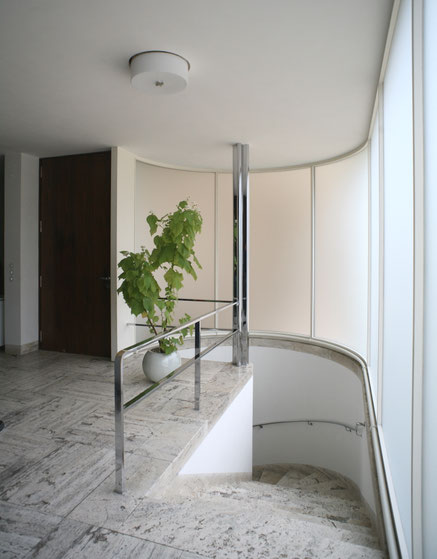
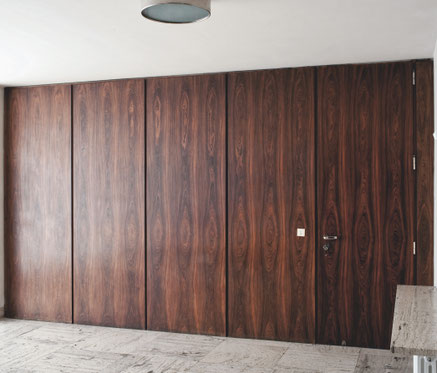
The glass wall is unique in the designs of Ludwig Mies van der Rohe. It was only possible due to the then-highest technical standards of Czechoslovakian glass production. It was superbly reconstructed during the 2010-12 restoration; the steel frame is still the original one.
At the end of the curved glass wall, like a snail shell, the floor-to-ceiling entrance door appears, veneered with precious Rio rosewood. The veneer continues into the door frame. Upon entering, visitors are greeted by a paneled wall that mirrors the motif of the front door four times. One of the panels is a door to a small passageway leading to both the terrace and the adjoining rooms.
To the right is the door (with a non-original door leaf) to the parents' bedrooms. Somewhat hidden behind the front door is the wardrobe (reconstructed in frosted and greenish glass in 2012), opposite is a mirror, and at the end of the hallway is an original paneled wall with a door leading to a dumbwaiter station and a restroom.
The hallway along the glass wall, which is a mirror image of the opposite one in the floor plan, is enclosed by a floor-to-ceiling wall with a steel frame and frosted glass. The glass door leads to the children's rooms, the children's bathroom, a storage room, and the nanny's room.
At the aforementioned initial meeting in the summer of 1928, Ludwig Mies van der Rohe told Grete and Fritz Tugendhat: "that a house should never be built from the facade, but from the inside out; that windows in a modern building should no longer be mere holes in a wall, but rather a surface spanning between floor and ceiling, and as such, a structural element!"
All the furniture in the house, designed specifically for it, is now reproduction of the drawings in the Mies van der Rohe Archive at MoMA in New York. As has been known since Christiane Lange's research in 2006, a large portion of the furniture drawings were created by Lilly Reich, Mies van der Rohe's partner and life companion.
The square travertine floor tiles are laid in a checkerboard pattern, alternating the direction of the natural sedimentary layers.
Originally, the glass wall was sandblasted to create a frosted effect; during the reconstruction, this effect was achieved through etching. Heating pipes at the travertine base prevent condensation on the glass.
The walls and ceilings of the Tugendhat House were not painted, but rather coated, like medieval panel paintings, with a polished base coat known as stucco lustro, which, with its pigmentation using fine sand, creates a marble-like effect. Similar wall surfaces can be found in outstanding buildings by Otto Wagner, Peter Behrens, and Ludwig Wittgenstein. The current surfaces were reconstructed using the same materials to protect the original finish.
This foyer—like the entrance—is not representative in the sense of the typical upper-middle-class villa iconography of the time, but rather has an intimate character. The path to the living quarters leads not upwards, but downwards. A spiral staircase made of travertine winds around the steel column, which is clad in directly chromed brass sheeting.
Perhaps the spiral staircases of the buildings by Emil Kralík or Bohuslav Fuchs (1928) on the Brno Fairgrounds served as inspiration—but in the work of Ludwig van der Rohe, the spiral staircase is unique.
The brass railing is—as is customary—first nickel-plated, then chrome-plated. To protect their young children, Ernst and Herbert, Grete and Fritz Tugendhat had the railing secured with wire-reinforced glass.
PARENTS' BEDROOMS
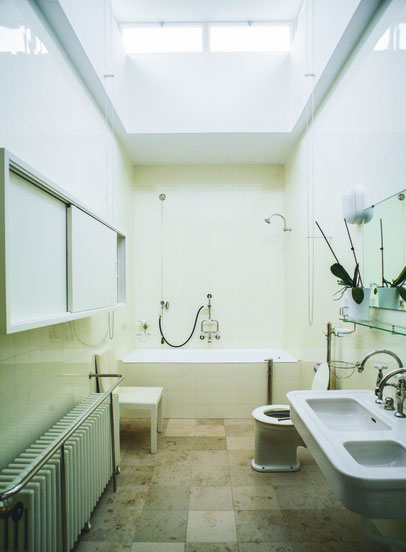
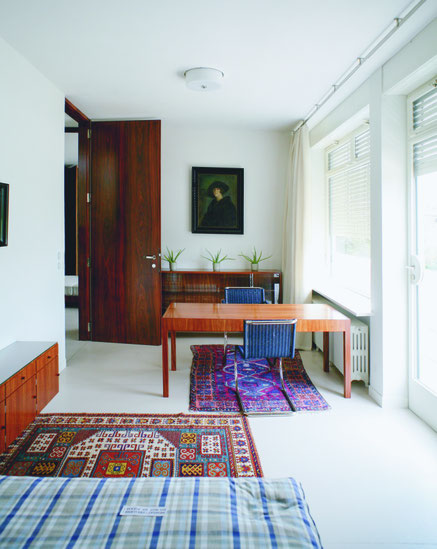
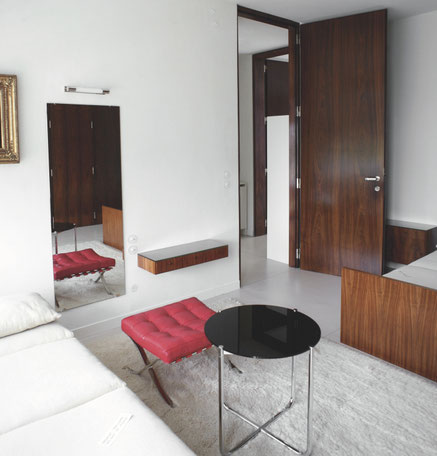

At the owners' request, the parents' bedrooms and the bathroom are not interconnected but rather separate rooms.
Like all the non-veneered wooden elements, the shoe cabinet and linen cupboard in the anteroom were coated with a precisely applied cream-white oil-based lacquer (the shoe cabinet is privately owned and was not returned to the owners).
The bathroom is notable for its lighting and ventilation provided by a skylight and its floor-to-ceiling tiling with cream-white tiles (reconstructed in 2010-12). The fixtures and fittings reflect the high-end style available in catalogs at the time.
In keeping with the upper-class custom of the time, the parents had separate bedrooms furnished according to the prevailing gender roles.
Both bedrooms feature large windows and a door leading to the terrace, as well as cream-white linoleum flooring (by the company DLW). The curtains were likely made of heavy shantung silk. The furnishings included a wall-mounted bedside table and floor-to-ceiling built-in wardrobes made of plywood, manufactured by the Brno-based company S.B.S., owned by the architect Jan Vañek. The screw joints used to connect the individual wooden panels can be considered precursors to the joints used in today's self-assembly furniture.
All the furniture in the parents' room was veneered with Rio rosewood on the outside and maple on the inside. As can be seen on light-protected sections of the original furniture, the rosewood veneer was stained a dark reddish-brown. The original veneer surfaces have since been sanded down.
Some of the furniture remains in the family's possession, some is in museums (Weimar, New York, Brno), and some remains in private hands and has not been restituted.
Fritz Tugendhat's room contained not only a standard narrow bed, but also a desk with two Stuttgart chairs without armrests (MR10) and a bookcase with glass sliding doors. A picture of Emil Tugendhat, Fritz's father, hung above the bookcase. One of the original carpets is still in the family's possession.
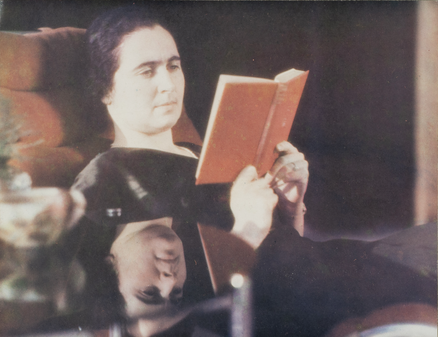
As photos of Fritz Tugend show, Grete Tugend used to read at this table; Fritz did not use it.
The ladies' bedroom is furnished in a 'gender-appropriate' manner: with a large, 140 cm wide bed, a natural-colored wool rug, a dressing table with a hanging cabinet and mirror, a so-called Barcelona ottoman, a Brno chair (MR50) in flat steel (a prototype), and a daybed. The (according to Grete Tugendhat) "cherry-red" upholstery of the ottoman and Brno chair was originally probably made of parchment (goatskin?).
BOYS' BEDROOM

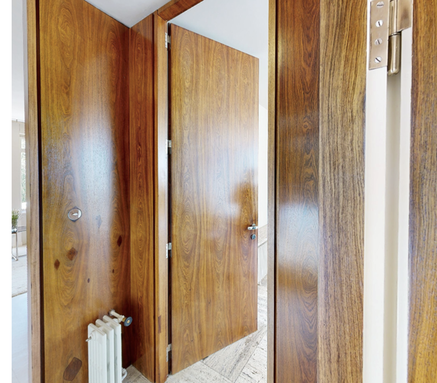
The passageway to the children's rooms, created at Grete Tugendhat's request, has doors and paneling with Rio rosewood veneer on three sides. Fittings designed by Gropius were used for the steel and glass door to the terrace. (The handcrafted, almond-shaped veneer repairs from 2012 have browned. This could have been avoided by the cooperation with conservators-restorers).
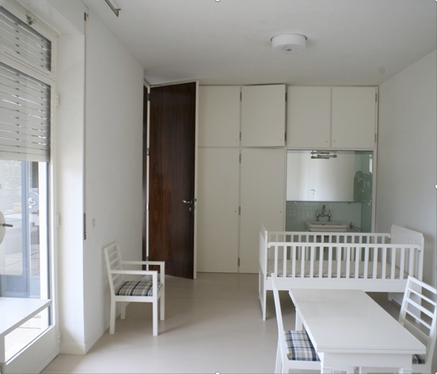
The boys' room, belonging to Ernst, who was born in his grandparents' house (1930-2023), and Herbert (1933-1980), was furnished with simple, lacquered children's furniture. The reconstruction of the built-in wardrobe also incorporated the glazed washstand visible in family photos. It can be assumed that the paint color of the built-in wardrobe and the children's furniture matched the cream-white of the original doors, windows, and patio door.
HANNA AND IRENE KALKOFEN'S BEDROOMS
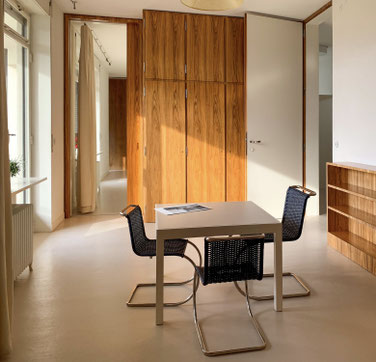
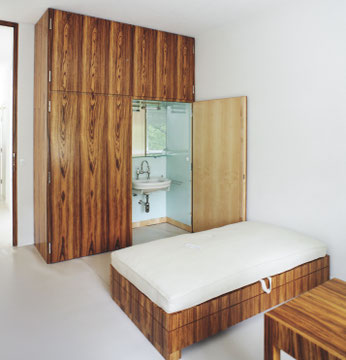
Hanna's room is accessed through a sliding door, which was reconstructed in 2010-12. The furnishings of this room were designed by Lilly Reich, naturally in collaboration with Mies van der Rohe. The entire interior is now an admirable reconstruction from 2010-12. The built-in wardrobes, the inside of the (original!) door, and other furniture are veneered with another exotic wood, this time African zebrano. The room contained two beds—the children's nurse could sleep here if visitors came or if the children were ill, and her room could potentially be used as a guest room. The special care provided to the children by a trained pediatric nurse, Irene Kalkofen, becomes more understandable when one knows that Grete Tugendhat lost three children after birth in her first marriage withHans Weiß.
The furnishings of Irene Kalkofen's room, which we see here, are a meticulous reconstruction from 2010–12. Designed by Lilly Reich in the same style as Hanna's room, it is also veneered with African zebrano. Behind one of the built-in wardrobe doors is a glazed area with a sink. During the day, the bedding could be stored in the bed frame. The furnishings also included a desk, a Stuttgart chair with armrests (MR 20) and, for relaxation, a Tugendhat armchair with a textile checkered cover (MR 70), and occasionally a piano.
2nd FLOOR:
RECEPTION AREA

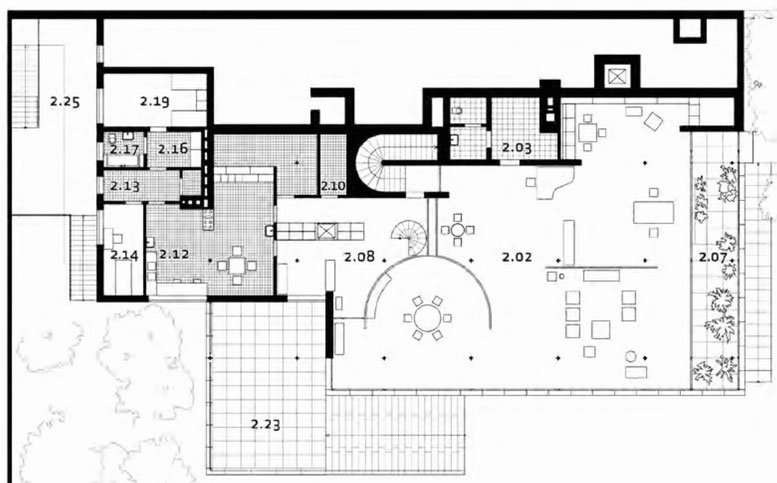
In her well-known speech in Brno in 1969, which she delivered in Czech, Grete Tugendhat quoted the architect Ludwig Hilbersheimer from 1931: “Photographs cannot convey any impression of this house. You have to move through this space; its rhythm is like music.” This space, of course, refers primarily to the approximately 237 square meter living area.
The aesthetic concept of the house culminates in this space. Of the 29 steel columns made of riveted and reinforced L-profiles, 11 are freestanding within this space and clad with chrome-plated, rounded, highly polished brass sheets. The columns support the concrete ceilings and allow for a free variation of the so-called flowing space. The outer boundaries of the space are formed on one side by the hillside wall and on the other, on three sides, by enormous glass walls, which are doubled in size for the conservatory.
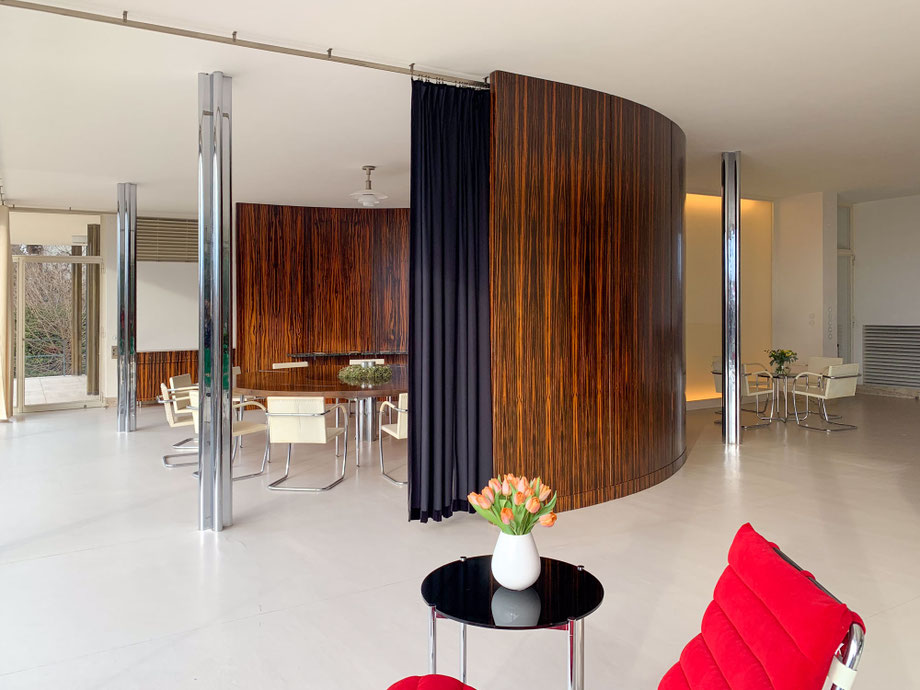
Within the space, there are only two fixed elements: the A floor-to-ceiling wall of onyx marble (geologically an aragonite) and the semicircular dining room wall veneered in Makassar ebony. The remaining room division is achieved by variable curtains in black or ivory velvet. These unusual, innovative curtain walls, the corresponding furniture arrangement, and the overall material concept are likely primarily attributable to the influence of Lilly Reich.
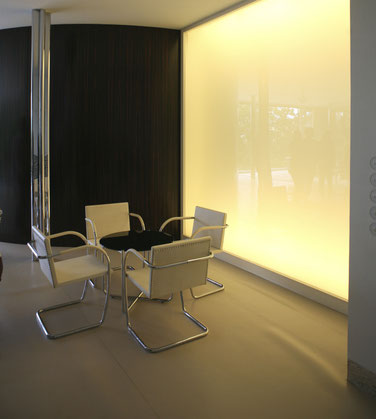
The entrance area of the large living room, accessed through a glass door with an ivory-painted steel frame, is accentuated by a seating area with a round glass table (MR140) and Brno chairs upholstered in parchment, positioned in front of a floor-to-ceiling frosted glass wall. Grete Tugendhat said in her aforementioned speech of 1969: “…we also enjoyed spending evenings with friends in front of the backlit glass wall that abutted the curved wall and gave off a soft, beautiful light.” A white velvet curtain hung between the entrance and the library, allowing this part of the living space to be completely closed off, creating an intimate seating area.
In fact, this area was probably more comfortable than the parts of the room where one had to rely on the ceiling lights.
The air conditioning unit's exhaust vent opens into the wall at the entrance to the living room. The air-conditioned air outlets are located along the conservatory and above the Makassar sideboard in the dining room area.
Even with the velvet curtains closed, one could see the piano and Lilly Reich's ivory-white lacquered display cabinet with semi-transparent bluish-black sliding doors (the original is on display in the basement). In front of the piano with its Stuttgart stool (MR1) is a door to the projection room (and toilet), which housed the so-called "locomotive," a 35mm film projector used to project films made by Fritz Tugendhat himself through an opening in the wall onto a portable screen. Unfortunately, the films disappeared in Berlin in 1938.
LIBRARY
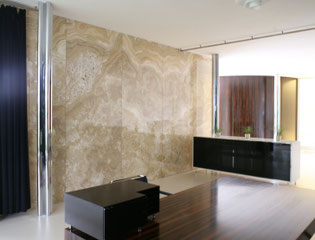
A truly exceptional functional and decorative element in the interior design of the house is the partition wall made of onyx marble. The sedimentary rock from the Atlas Mountains in what was then French Morocco in North Africa was sawn into five slabs from a huge block that Mies van der Rohe had found in Hamburg. The height of these slabs determined the room height during the planning phase. The garden facade of the house faces southwest. On sunny days, when the sun's rays shine through the glass walls and directly onto the onyx wall, the semi-transparent wall begins to glow golden yellow.
Like the entire furnishings of the main living room, the library was also veneered with Makassar ebony from the Makassar region on the island of Sulawesi in Indonesia. The surface of the Makassar ebony veneer throughout the living room, as evidenced by the surviving original furniture, was stained a dark reddish-brown and polished. This somewhat obscured the pattern of the picturesque grain, giving way to a refined reflection.
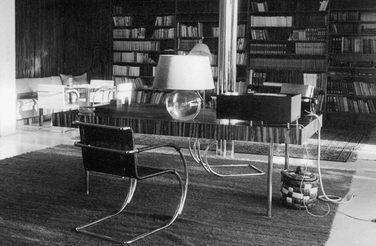
The built-in features are still largely original (except for the shelves). A safe was hidden behind the former beverage rack on the east side. The dilapidated library sofa, upholstered in goatskin parchment, is privately owned in Brno and has not been restituted. The so-called bridge table, at which benefit bridge tournaments were played as part of the League for Human Rights, is located in the Bauhaus Museum in Weimar, along with some other furniture from the Tugendhat House. The side tables are still in the family's possession, but the remaining library furniture, including two wicker chairs (MR20), the desk with filing tray, the parchment-covered Brno chairs, and the leather-upholstered Tugendhat chair, has disappeared. Although the library was designated as the "master's workplace" in the plans, Fritz Tugendhat himself stated that he rarely used the desk.
The library was, according to his own account, the master's workspace. “Grete and Fritz Tugendhat were alone in the large room in the evenings and usually sat in the library. The children ate with the nanny in Hanna’s room,” reported Daniela Hammer-Tugendhat.
The table lamp with the water-filled body, visible in Fritz Tugendhat’s photographs on the desk in the library, was only installed in 1931 and is probably Grete Tugendhat’s idea. No other lighting besides the ceiling lights is documented. The large glass panes of the conservatory had curtains of black shantung silk, and the space between the conservatory and the onyx wall could be closed off with a black velvet curtain. Around 1932, a brown natural wool rug woven by Alen Müller-Hellwig in Lübeck replaced the oriental rug under the desk.
SEATING AREA IN FRONT OF THE ONYX WALL
In 1933, Ludwig Mies van der Rohe formulated his aspirations as an architect as follows:
Only the glass skin, the glass walls, give the skeleton structure its clear structural form and secure its architectural possibilities. [...] Only now can we freely structure the space and integrate it into the landscape
He was able to realize these ambitions together with Lilly Reich at the Tugendhat House without financial constraints and in close cooperation with the clients:
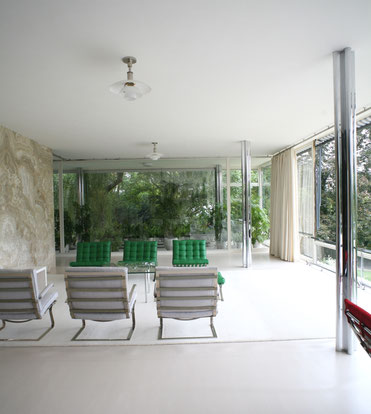
The most spectacular feature is the 3-meter-high, up to 16-square-meter wall made of 10-millimeter-thick mirror glass, presumably the largest ever used in a private home. Two of the panes, the one in front of the seating area and the one in front of the dining room, are electrically retractable—not a unique technical feature, but rarely used (e.g., in Peter Behrens' Villa Gans). The two panes can be fixed at any desired height using control knobs on the northwest wall.
White linoleum was chosen for the flooring. According to Grete Tugendhat (1969), Mies van der Rohe wanted "the floor to appear as a single, unified surface, which is not the case with parquet, and white was the most neutral color."
Regarding the heating of this room, Grete Tugendhat said in 1969: “To avoid disfiguring the large room with radiators, an air conditioning system was installed, which could also be used for cooling in the summer.” And concerning energy efficiency, she made the following remarkable observation: “…the solar heating through the 10 mm thick mirrored glass panes was so strong that on sunny winter days, even at very low temperatures, we never had to heat the lower room and could even lower the large windows electrically and then sit as if outdoors.” To prevent condensation, hot water heating pipes were installed in the floor, which still serve as room heating today. Gray-white striped exterior awnings provided protection from direct sunlight.
The chrome-plated railing was only installed in 1931 for safety reasons.
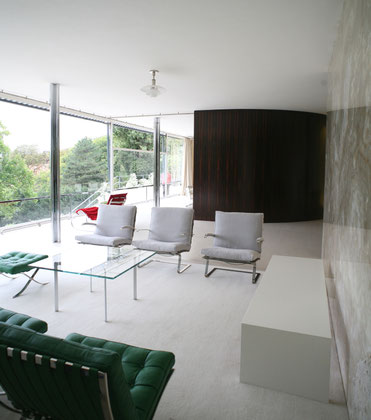
Among the room's functional elements, the seating group in front of the onyx wall is particularly representative:
A yellowish-white wool rug woven by Alen Müller Hellwig in Lübeck (the industrially woven rug from 2012 is completely different), a bench table (the original is in the museum's collection), three Tugendhat chairs with silver-roughened leather upholstery, three Barcelona chairs (the originals are in the museum's collection), and an ottoman (the original is currently in the MAK in Vienna with goatskin parchment upholstery dyed "emerald green" according to Grete Tugendhat's design), and the Dessau table with a glass top (the original is in the basement).
In front of the onyx wall stood the sculpture "Torso of the Striding Figure" by the German sculptor Wilhelm Lehmbruck from 1914, cast in stone and selected by the clients; today, a free reproduction in bronze (pre-1989?) stands out.
A further (variable) accentuation of a space in the room is achieved by the chaise longue with its "ruby-red" upholstery (the original is in the basement), inspired by Grete Tugendhat, and a small glass side table.
The reflection of the conservatory plants in the polished onyx wall, which appears as a stark, machine-like aesthetic, is irregular, alluding to its handcrafted production and the traces thereof, i.e., the facture of the stone slabs.
MATERIALITY
Mies van der Rohe had explained to the young married couple Grete and Fritz Tugendhat, who visited him in his Berlin office on New Year's Eve 1928 to discuss the plans, "how important the use of precious materials was, especially in modern, so to speak, unadorned and ornamented architecture, and how this had been neglected until then, for example, by Le Corbusier."
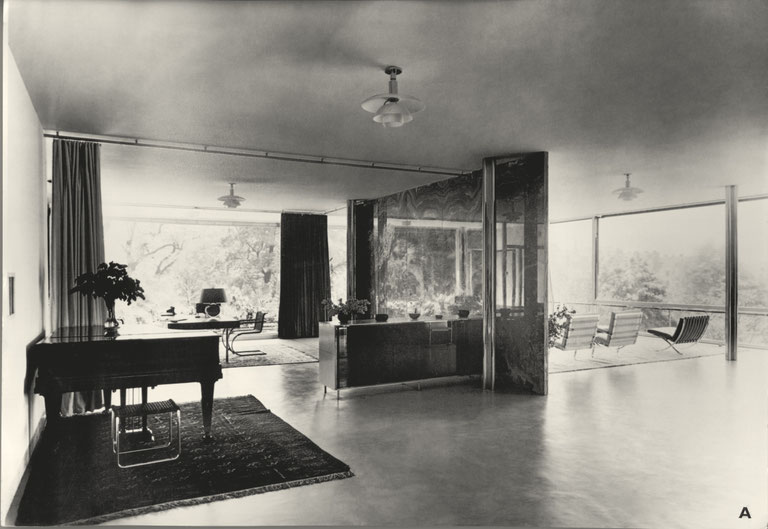
Ludwig Mies van der Rohe and Lilly Reich, however, not only used precious materials such as onyx marble, polished chrome and nickel, fine woods, parchment, natural silk, and mirrored glass, but also traditional materials in the 'simple,' handcrafted elements, such as the polished oil lacquer finish on wood and metal and the stucco lustro on the walls and ceilings. Just as a gemstone only reveals its beauty through cutting, so too does the surface of all materials achieve its effect not only through its structure but also through the extraordinarily precise craftsmanship involved in its finishing. Wood and stone reveal cross-sections of natural processes and act as painterly, rhythmic ornaments. Yet, at the same time, the polished, reflective surfaces subvert the iconic effect of the materials' presentation. The impression of floating ceiling surfaces is enhanced by the materiality of the polished stucco lustro.
Black and natural-colored curtains in velvet and silk integrate seamlessly into the aesthetic continuum of an architecture oriented towards the inherent color of the materials.
Mies van der Rohe and Lilly Reich used subtly selected bright colors only in individual pieces of furniture. In daily life, these were complemented by the colors of the abundant cut flowers, vases, and other ceramic vessels.
The way in which architectural form, interior design, furniture design, and materiality have fused into an inseparable whole transforms the house into a GESAMTKUNSTWERK (total work of art). The convergence of the architects' and clients' aspirations was a stroke of historical good fortune. In this house, the modernist dream of the late 19th and early 20th centuries—to unite architecture and art, art and life, life and nature, to counter the commodification and fragmentation of art media, and to integrate the various media into a GESAMTKUNSTWERK—was realized in its highest form. Perhaps for the last time, the house also bears witness to a bygone era.
In 1931, Justus Bier posed the question in the journal Die Form: "Can one live in the Tugendhat House?" This sparked a controversial debate in which Grete and Fritz Tugendhat also took a stand. Daniela Hammer-Tugendhat wrote about this (1998):
This house appears to me like a garment, like the very essence of my parents' being made manifest in architecture, as I experienced and perceived them, with all their ambivalences: the admirable striving for 'spirituality' and 'truth,' which at the same time also implies great rigor and an almost inhumanly high standard. Justus Bier's question, "Can one live in the Tugendhat House?" can perhaps be answered this way: My parents could.

DINING ROOM
The Tugendhat family was only able to enjoy their home for eight years. In 1938, they had to flee Czechoslovakia from the advancing Nazis and their supporters, and the house was confiscated by the GESTAPO..
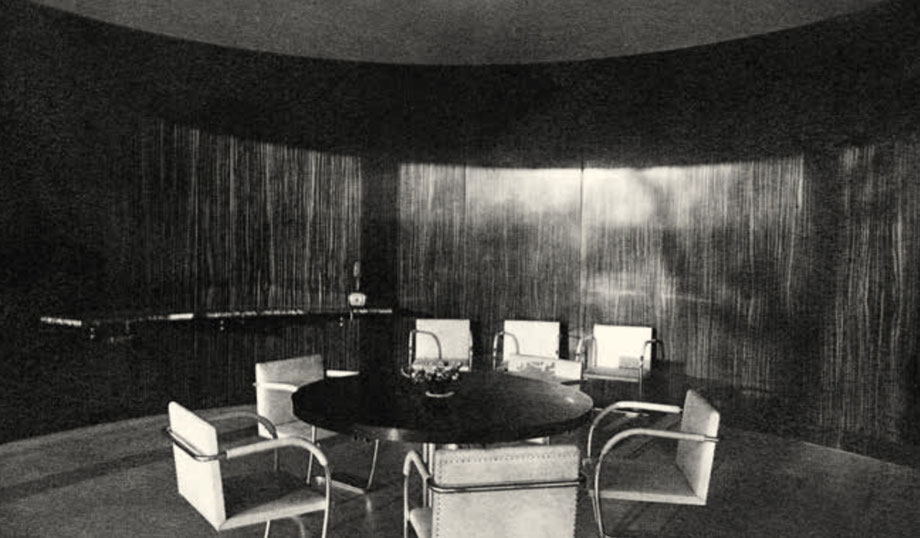
As early as 1940, the original semicircular wall that defined the dining room was dismantled, and—as art historian Miroslav Ambroz discovered in 2011—the veneer was used as a parapet in the Gestapo's party room in the Law Faculty building of Brno University, rotated 90 degrees. For the reconstruction, these surviving pieces of veneer were reused on the inside of the wall; the outside has been reconstructed. Thanks to photographs by Fritz Tugendhat, we know how the landscape was reflected in the evening sun on the original, dark-stained and polished surface of the veneered wood.
The original, now reconstructed, tabletop was made of a bluish-green serpentinite breccia, the only splash of color in the dining room's decor besides the veneered wood surfaces. The table stands on a single leg made from the same elements as the chrome-plated columns of the supporting steel structure. It could be extended in two circular sections, allowing up to 24 people to sit at it. However, the family lived a very secluded life, eating alone in the evenings, and the extension was rarely needed. The tabletop was originally made of black-stained pearwood, like the interior of Lilly Reich's display cabinet.
The original Brno chairs in the dining room, whose whereabouts are unknown, were upholstered in natural-colored parchment, probably goatskin.
The dining room ensemble also includes the Makassar sideboard, the original of which has been preserved.
With curtains of natural-colored shantung silk and a black velvet curtain, an intimate space was created.
ON THE HISTORY OF THE TUGENDHAT FAMILY AND HOUSE AFTER 1938
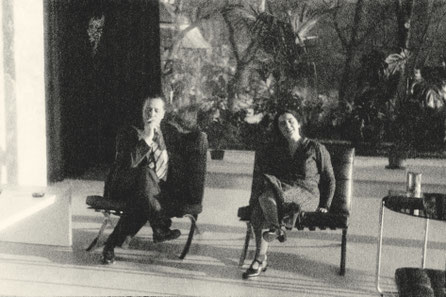
In Rudolf de Sandalo's publication photographs from 1931, the house appears—as is still customary in such photographs today—without people. Life in the house is documented in private photographs taken by Fritz Tugendhat, which Daniela Hammer-Tugendhat first published in 1998 in a book about the Tugendhat House (latest edition 2020), available in the museum shop. These photographs were also used for the house's restoration from 2010 to 2012.
The Tugendhats' escape into exile initially led them to Switzerland in January 1941, and then to Caracas, Venezuela, after Switzerland expelled the family. Fritz Tugendhat was able to take some of the furniture and other furnishings with him into exile before the entire Czechoslovakia was occupied by the German Wehrmacht on March 15, 1939. Some members of the Tugendhat and Löw-Beer families who did not emigrate were murdered by the Nazis. From June 1943 to April 1945, Walter Messerschmidt, the commercial director of the Klöckner Works, resided in the Tugendhat House. Messerschmidt commissioned several renovations.
Damage sustained during the war and the liberation in April 1945 by Allied bombing and Soviet troops primarily affected the large glass panes.
Thanks not only to excellent construction techniques but also to careful use and maintenance, the house has survived to this day: from 1945 to 1950 as Karla Hladka's private dance school, then until 1980 as part of the children's hospital, after its first restoration from 1980 to 1985 as a VIP hotel, and since 1994 as part of the Brno City Museum.
In 1948, it was officially confirmed that the Tugendhat family possessed Czechoslovak citizenship. The restitution claim submitted by Fritz Tugendhat on September 8, 1949, was rejected in 1950 due to socialist expropriation. From 1967 onward, the family actively participated in Brno's efforts to preserve and restore the house. (After the Velvet Revolution of 1989, restitution was only possible for a brief period in 2001 and only for agricultural properties.)
Even today, one can still read, including in publications of the Brno City Museum, that the Tugendhat family were "German Jews." This creates the unjustified impression that the Beneš Decrees of 1945, which applied to German property, also applied to the Tugendhat house. Grete and Fritz Tugendhat were Czechoslovak Jews who predominantly spoke German.
In 1992, Václav Klaus and Vladimír Mejčar negotiated the peaceful dissolution of Czechoslovakia into two independent states, effective January 1, 1993, in the garden of this house, and undoubtedly at this very table.
The family's application in December 2006 for the restitution of their property as a work of art, in order to remove the house from the legal disputes surrounding the restoration tender, was ultimately rejected in 2007, and the house remained the property of the City of Brno.
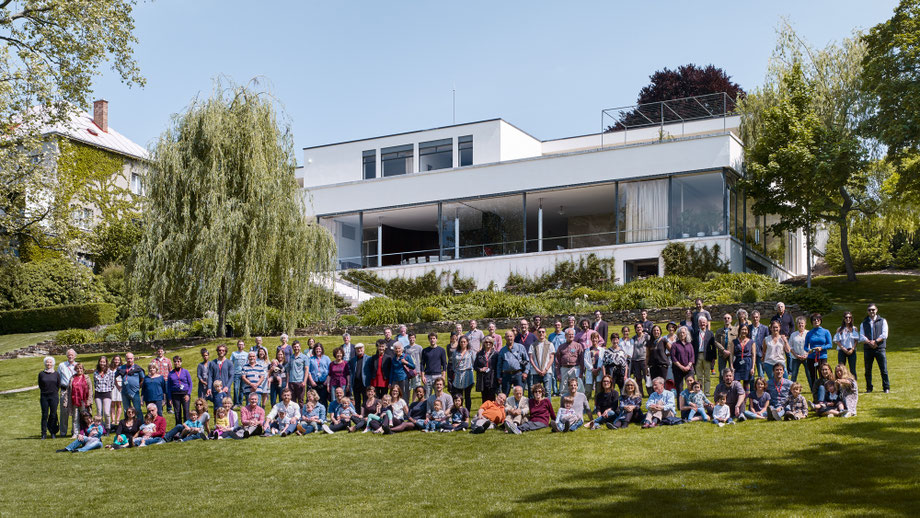
However, the family refrained from further legal action and continued to actively participate in the preparation and execution of the restoration from 2010 to 2012. Daniela Hammer-Tugendhat served as honorary chair, and her husband Ivo as chair, of the international expert commission THICOM, which advised the City of Brno on the house's restoration. Descendants of Grete and Fritz Tugendhat were present at the house's reopening after the restoration on February 29, 2012. Daniela Hammer-Tugendhat gave a speech, which is documented in our book (last edited in 2020 and available in the museum shop). A 2013 film by Dieter Reifarth tells the story of the Tugendhat House and its inhabitants in several languages; the film is also available in the museum shop.


PANTRY
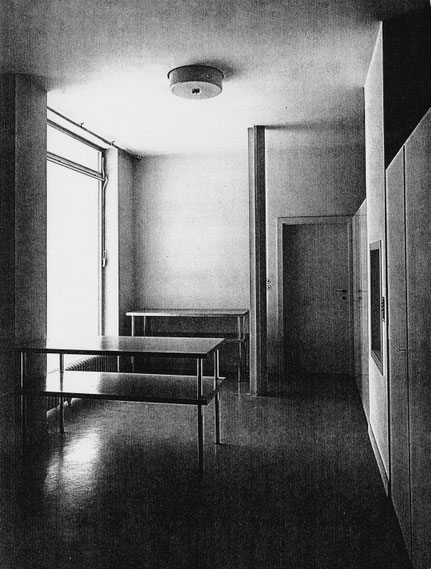
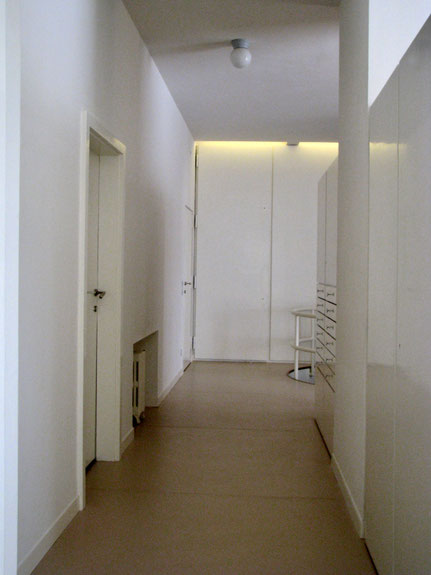
Between the main living room and the kitchen is a pantry, from which a steel spiral staircase leads down to the utility floor. A dumbwaiter, connecting all three floors of the house, also opens into this room. Ivory-white lacquered built-in cupboards for dishes are attached to the elevator shaft. A larder is located behind the room. In front of the large frosted-glass window, which obscured the view of the family's garden terrace, stood two tall sideboards, reflecting the architectural principle of the house.
KITCHEN
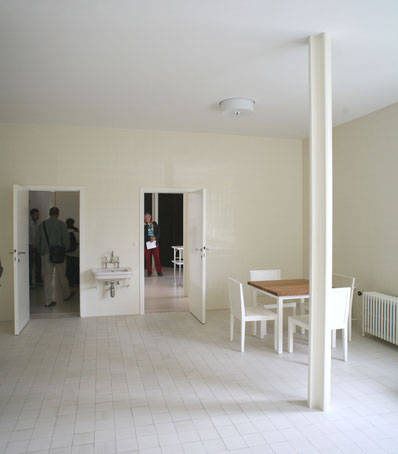
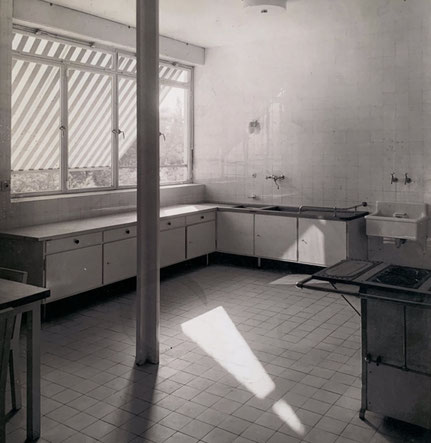
The kitchen forms a connection between the living quarters and the staff quarters in the floor plan. A stove with a chimney, and probably a gas connection, stood against the east wall. The kitchen counter was equipped with two sinks and a metal sink. The view from the southwest-facing window onto the garden terrace was obstructed by a pane of frosted glass. In the corner stood a square wooden kitchen table with four simple, varnished wooden chairs, their backs and seats upholstered in parchment covers (these pieces of furniture are said to still exist in the neighborhood). Opposite the table is a cream-white built-in cupboard, separating the pantry. The kitchen walls are tiled in cream-white up to the ceiling, while the floor is covered with similarly colored RAKO ceramic tiles in a slightly darker shade. The steel columns are not clad but painted cream-white. The staff quarters on the second floor housed the cook's and chambermaids' rooms, which now serve as offices for the museum staff.
1st FLOOR
AIR CONDITIONING
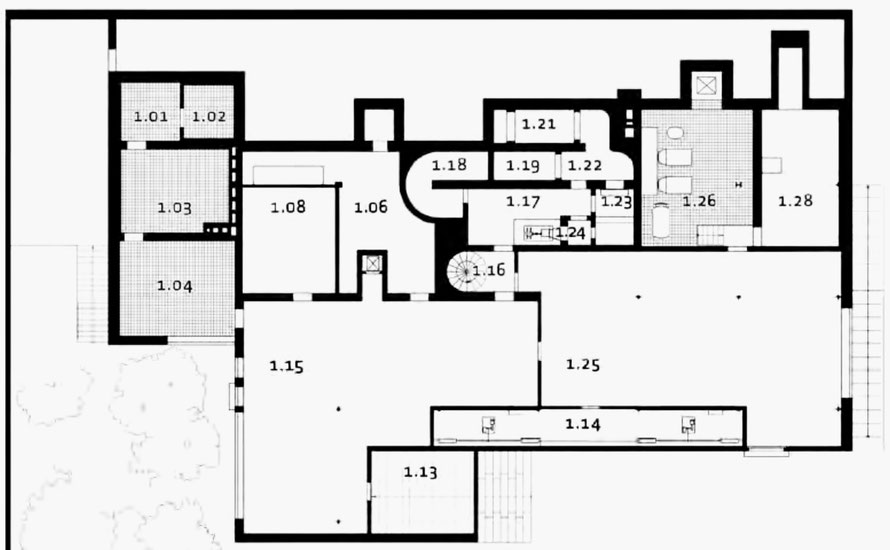
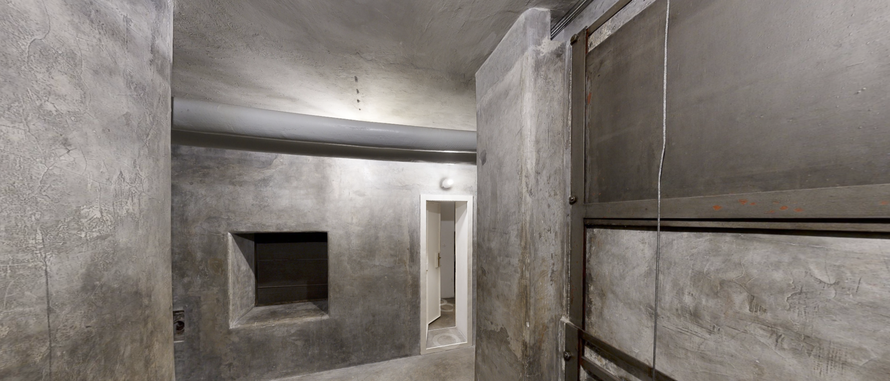
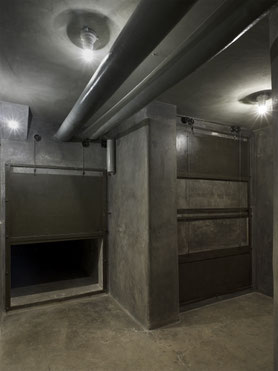
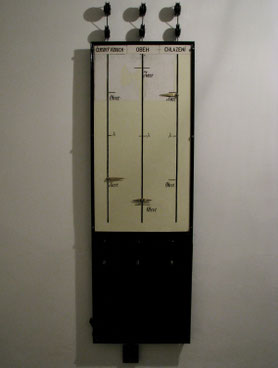
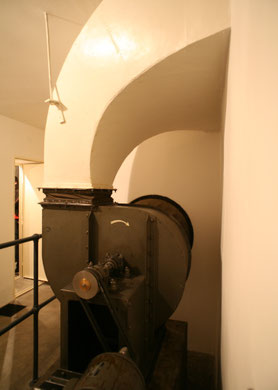
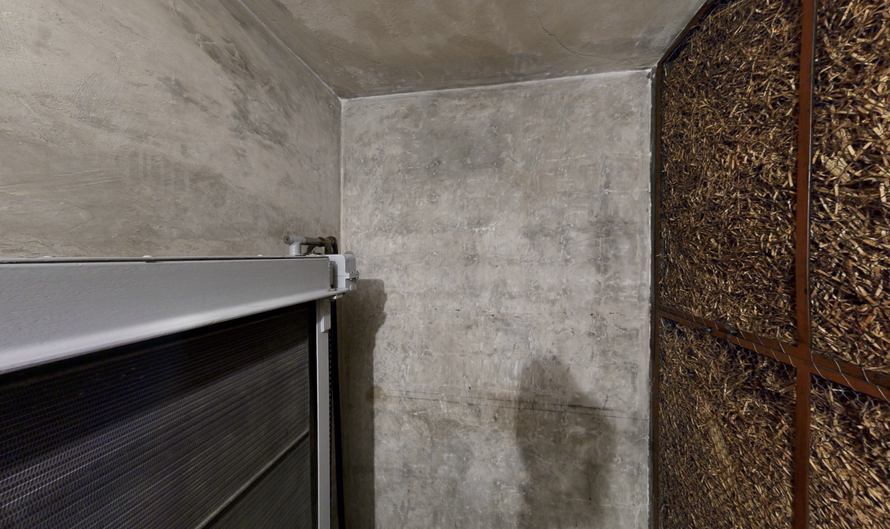
An air conditioning system with its own dedicated room was rather unusual in a private home in 1930; the technology originated in warehouses or industrial settings. Filtered, humidified, and thermally treated air is supplied to the main living area. A simple control panel with movable cranks serves as the regulator. These controls allow for manual regulation of fresh air intake, circulation/temperature, and cooling. The air is cooled and humidified in a special trickle chamber, the floor of which is lined with salt stones. Water flows onto these stones from nozzles inserted into a longitudinal water pipe. Filtration is achieved through a rotating, clock-driven oil filter and a wood wool filter that traps the oil odor. A heat exchanger warms the air. Air circulation is provided by an electric radial fan (the original SVET motor dates from 1942). The fan is mounted on a concrete base with a cork interlayer to prevent vibrations from being transmitted to the foundations. The steel railing around the fan is original. After the described treatment, the air is supplied to the main living area. The system functions as ventilation and gentle cooling, but primarily as a warm-air heating system. The entire ventilation system is preserved in its original condition, with only minor exceptions, and is fully functional, but it is not currently in operation.
AUDITORIUM (GARDEN CELLAR)

This room originally served as a storage space for garden furniture. The permanent exhibition provides information about the history of the house, as well as about the owners and the architect. The exhibition also features photographs by Fritz Tugendhat from the 1930s. In 2019, the exhibition was expanded to include information about Mies van der Rohe's life and work partner, Lilly Reich. This room is regularly used as an auditorium for lectures, seminars, and short exhibitions. From a structural engineering perspective, the exposed structure of the riveted L-profile cross-section columns, the routing of the ventilation system under the ceiling, and the foundation for the onyx partition wall in the main living area are particularly noteworthy.
BOILER ROOM
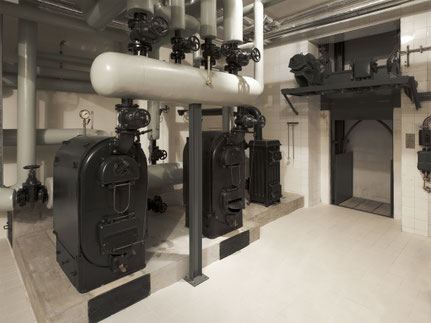
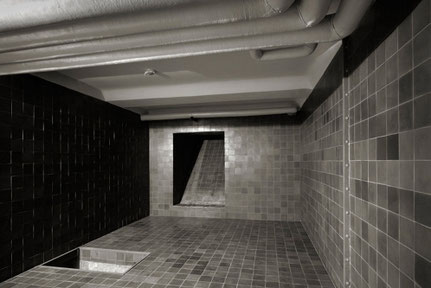
During the villa's first renovation in the 1980s, the coke oven room, containing two Strebel boilers, was converted into a heat exchanger station connected to the city's district heating system. The only remaining elements of the original equipment are the ash elevator, which leads through a hatch to the technical terrace in front of the building, and some of the original cream-colored tiles. The elevator was restored in 2010-12. At the same time, two refurbished historic Strebel coke ovens and a hot water boiler were installed in their original locations. Given its age and condition, one of the boilers has only been operated once. Next to the boiler room is a coke storage area where the original coke feed chute, with its black tiled lining, has been restored.
WINDOW LIFTERS
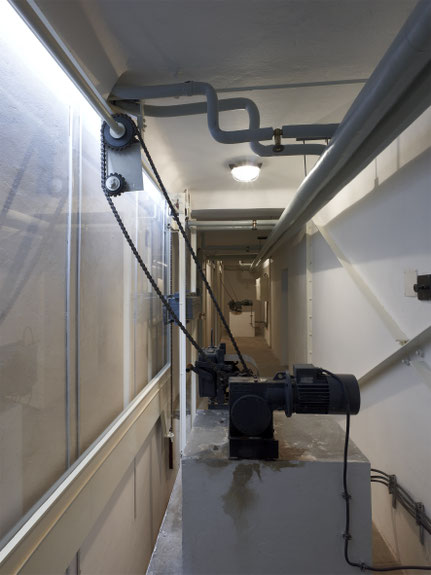
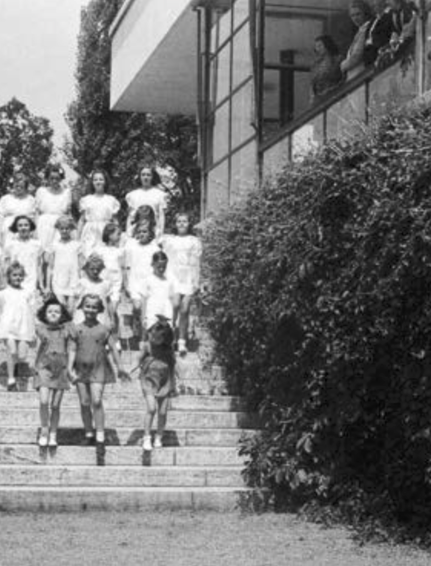
During the renovation in the 1980s, the system was refurbished and fitted with new electric motors from Košice. As part of the building's second restoration from 2010 to 2012, the system was fully restored. The retractable brass louvers, which prevent water from entering the engine room when the windows are lowered, were only partially intact and were replaced. In this room, the horizontal reinforcement of the steel support structure, known as the St. Andrew's Cross, is clearly visible in the wall. Due to the considerable mechanical stresses, the mechanism is no longer activated during every guided tour.
MUSEUM SHOP
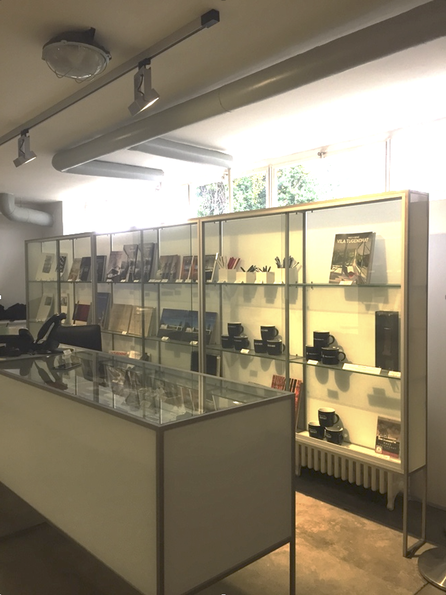
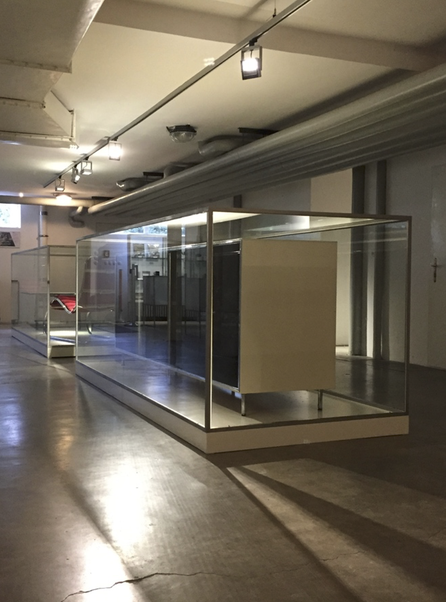
Originally, the room was used for drying laundry and ironing. It also housed a storage room for fruits and vegetables and a dumbwaiter. Currently, it contains an exhibition and visitor center as well as the ticket office.
Since October 2015, original pieces of furniture from the house's main living room have been on display in special display cases in the exhibition space:
• Display case made of white lacquered wood with supporting steel tubes and glass sliding doors; designed by Lilly Reich, 1930, manufactured by S. B. S. Brno
• Table from the seating area in front of the onyx wall, made of chrome-plated steel strip with a glass top (not original); Design by Ludwig Mies van der Rohe, 1930, manufactured by Berliner Metallgewerbe, Joseph Müller
· Elegant chaise longue made of cantilevered tubular steel with renewed red upholstery, fastened with leather straps and buckles; design by Ludwig Mies van der Rohe, 1931, manufactured by Bamberg Metallwerkstätten.
This furniture collection was discovered in the 1960s in Brno, near the house, by the architect Jan Dvorák, who was known to the family. It was not restituted and was sold to the Moravian Gallery. In 2014, after the furniture was restituted to the family, the City of Brno, with the support of the City of Vienna, purchased the furniture, which had been subject to an export ban, from the Tugendhat family.
LAUNDRY, DARKROOM, "MOTH-CHAMBER"
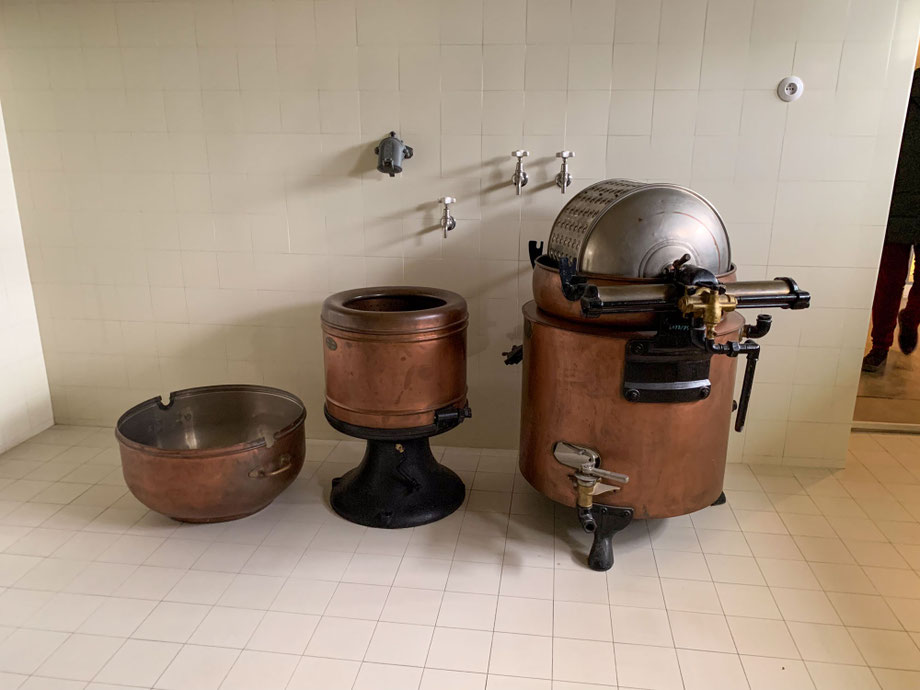
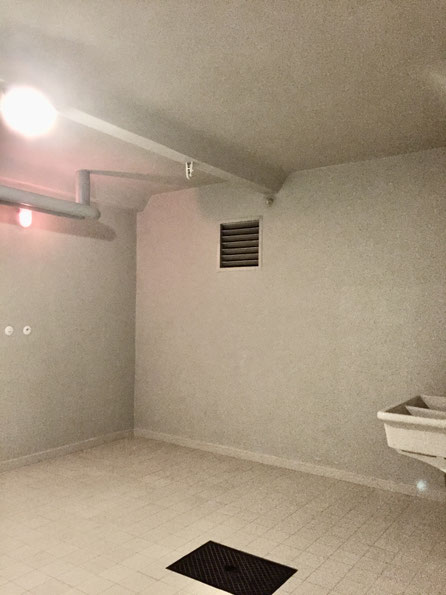
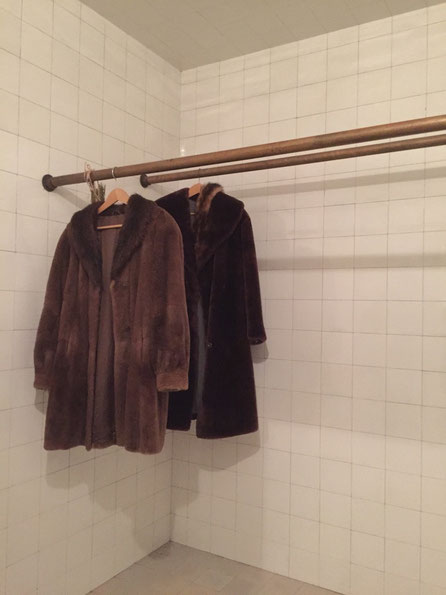
Behind the former ironing room, now the ticket office, are three rooms: a laundry room, Fritz Tugendhat's darkroom, and behind that, the so-called moth chamber. The darkroom has a ventilation system, including a chimney connection; corresponding circular openings can be seen on the facade of the driver's apartment in the entrance area.
Nothing remains of the original furnishings of the laundry room and the darkroom, but the rooms have been decorated with historical artifacts for illustrative purposes.
The room designated as the "moth chamber" in the original plans served to store winter clothing. Aside from Grete Tugendhat's winter coat, her fur stole, and summer wool clothing, nothing else was hung there. The room has been preserved in its original form, meaning it features authentic stoneware tiles on the walls and ceiling, slightly darker ceramic floor tiles, and brass clothes racks.
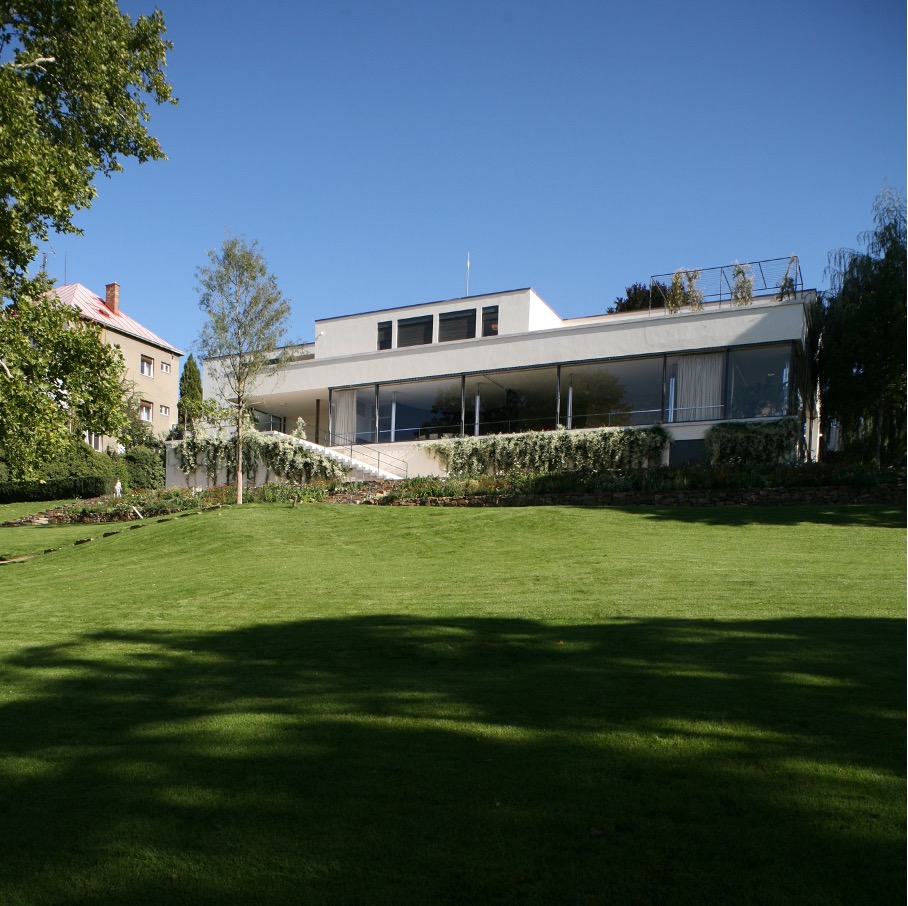
GARDEN
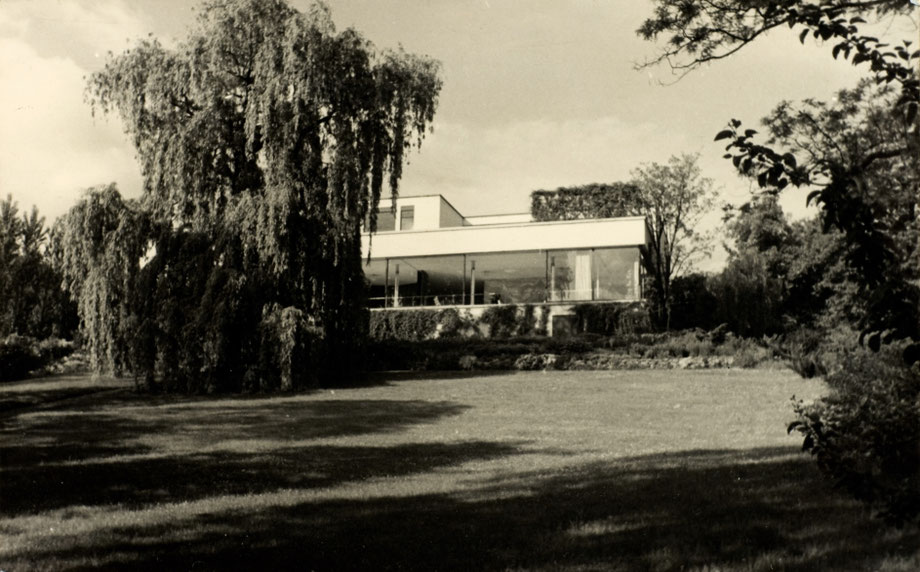
The garden, covering almost 6,000 square meters, was designed by Ludwig Mies van der Rohe in collaboration with the Brno landscape architect Markéta Müllerová. Historical plans from 1909 show that the path system originated from the English garden of the Art Nouveau house built in 1904, which was occupied by Grete Tugendhat's family from 1913 onwards. At that time, this area did not legally belong to the Tugendhat house, but rather to Grete's parents' house.
The area in front of the Tugendhat house is dominated by a large lawn, conceived according to the concept that Mies van der Rohe described as "emphasized emptiness."
In 1969, the double quarry stone terrace, which, viewed from the garden, serves as a mediator between the garden and the building, was reconstructed using dressed stone, thus recreating a feature that had been planned but not implemented in 1930. Between 2010 and 2012, the original state was restored, including the dry stone walls. The vegetation on the lower facade and the upper terrace was already included in the original plans.
Notable solitary trees include a maple (left), a weeping willow, Grete Tugendhat's favorite tree, on the semicircular terrace beneath the rubble stone garden steps (with garden furniture that still exists in the neighborhood), a spreading plane tree below the willow, and finally the Japanese pagoda tree under which Václav Klaus and Vladimir Mejčar negotiated the division of Czechoslovakia. A herb garden is located on the northwest side of the house, below the garden terrace and the kitchen window.
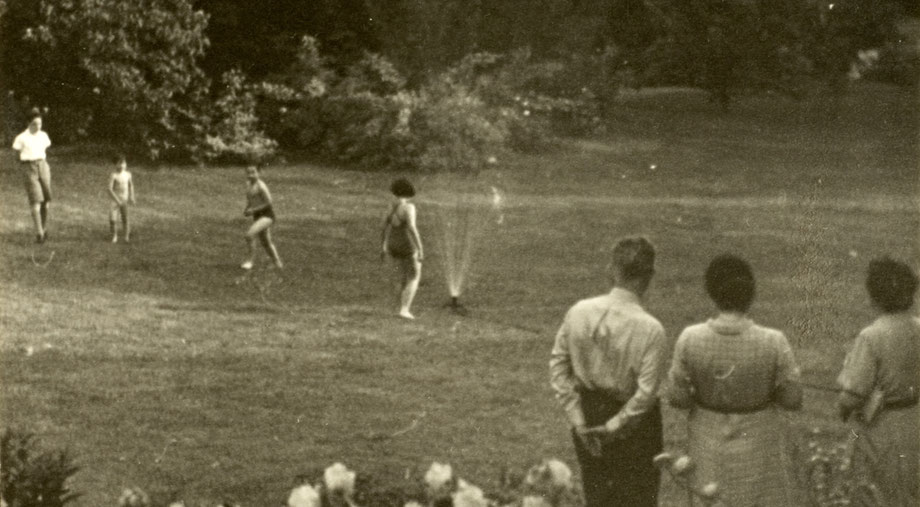
The summer seating area beneath the weeping willow was aligned with the dining room. Daniela Hammer-Tugendhat wrote: “The garden, largely left as a meadow, offered a small playground paradise for the children, who used it for their activities in both summer and winter. In winter, the children could sled and ski all the way to their grandparents' house. The idea of freedom that was so important to Mies could be realized here – for this small, affluent family.”